
METAL CASETTES
Facing panels made of metal have good aesthetical, economic and ecological features.Aluminium, galvanized or stainless steel and cuprum are used as raw materials for production of this kind of facing.
Facing is made of thin metal sheets and produced in a form of linear panels, profiled sheets and metallic panels of any sizes, forms and color. Powder paint or polymer film is used for coating.
The use of this kind of facing allows designers to select easily the required combination of colors and forms for architectural ensemble being developed.
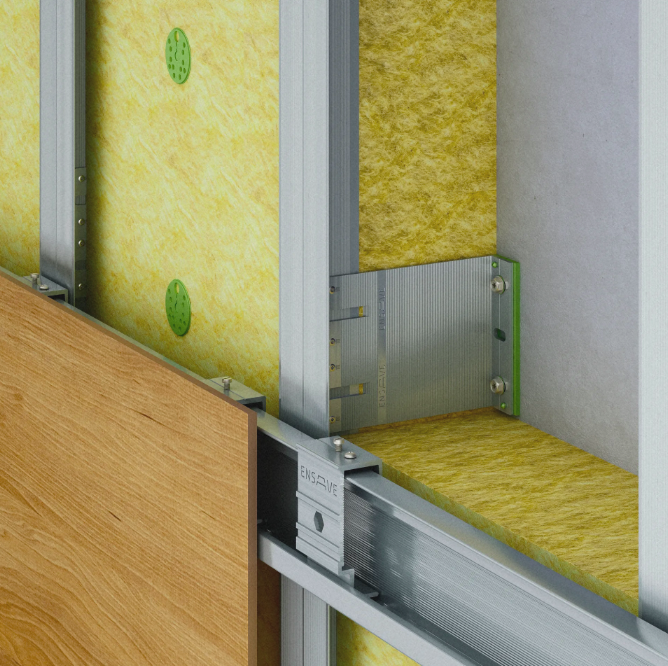
Invisible Linear Panels – screw
MVe-Light V01
EnVe-Light V01
This aluminum system is designed for vertical substructures in ventilated facades, consisting of wall brackets, profiles, and accessories. Bracket extenders allow for different cladding offsets. Wall brackets are available in 45–305 mm (with isolator) and 40–300 mm (without isolator), in 10–30 mm increments, and three sizes (S, M, L). Various hole geometries in the base plate suit anchor or screw installation.
Brackets with preassembled isolators reduce thermal bridging by separating the substructure from the wall, enhancing overall thermal performance. For attaching profiles, brackets feature fixed and sliding points. The fixed point supports façade and window loads, while the sliding point compensates for thermal expansion. Clear markings prevent installation errors.
Vertical profiles are connected using special screws or rivets, ensuring secure fixing at the fixed point and frictionless movement at the sliding point. A built-in fastening clip aids alignment and reduces mounting time.
Cladding materials, such as aluminum cassettes and composite panels, are attached using clips and hooks. The clip is fixed to the profile with a setscrew, and panels are hung using hooks pre-mounted on their edges, ensuring a secure and adjustable façade solution.
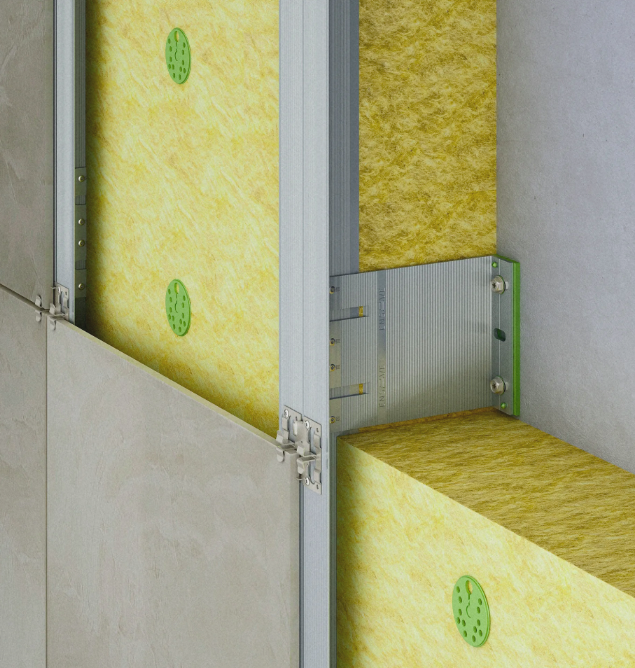
Invisible Cassettes – bolt system
EnVe-Light V07
The system consists of aluminum wall brackets, profiles, and accessories designed for vertical substructures in ventilated facades. Bracket extenders allow for various cladding offsets. Brackets with isolators are available in lengths from 45–305 mm; without isolators, from 40–300 mm, in 10, 20, or 30 mm increments depending on length, each in sizes S, M, or L. Brackets come with different hole geometries in the base plate for installation using anchors or screws.
Brackets with preassembled isolators reduce thermal bridging by separating the substructure from the base material, improving the building’s overall thermal efficiency.
Each bracket has two fixing points: fixed and sliding. The sliding point compensates for profile expansion, while the fixed point supports the cladding and proportional window loads. Both points are marked and scaled to prevent mounting errors.
Vertical profiles attach to wall brackets using specially designed screws or rivets. The fixed point holds the profile in place, while the sliding point allows movement to prevent stress from expansion. A built-in fastening clip holds the profile during installation, simplifying alignment and reducing mounting time.
Cladding materials, such as aluminum cassettes and composite panels, are attached using clips and hooks pre-fixed to panel edges.
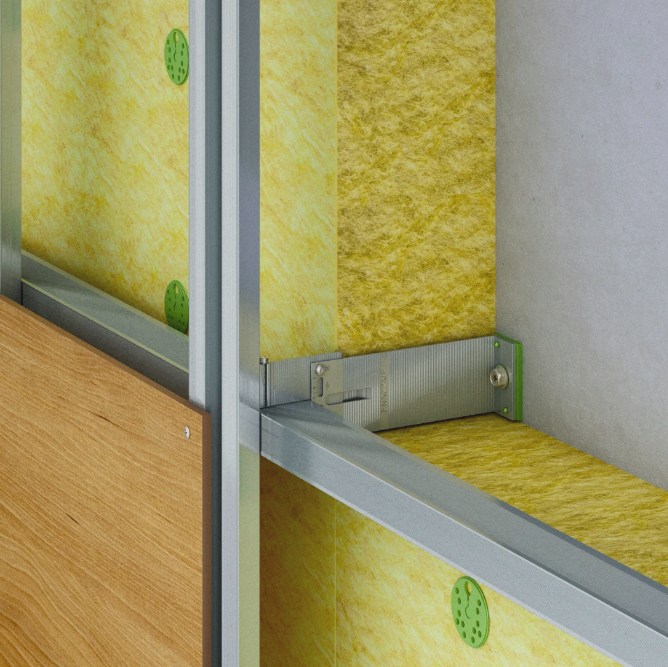
Invisible composite – adhesive
MVe-Light V02
EnVe-Light V02
This aluminum system is designed for vertical substructures in ventilated facades and includes wall brackets, profiles, and accessories. Bracket extenders allow for various cladding offsets. Wall brackets range from 45–305 mm (with isolator) and 40–300 mm (without isolator), in 10–30 mm increments, and come in three sizes (S, M, L). They are available with different hole geometries for anchor or screw installation.
Brackets with preassembled isolators minimize thermal bridging by separating the substructure from the wall, enhancing the building’s energy efficiency. Each bracket has fixed and sliding fixing points: the fixed point supports façade and window loads, while the sliding point compensates for thermal expansion. Both points are clearly marked to prevent mounting errors.
Vertical profiles are connected using special screws or rivets, allowing secure attachment at the fixed point and frictionless movement at the sliding point. A fastening clip aids in alignment and simplifies installation.
Cladding panels are fixed to the profiles using liquid nails and double-sided adhesive tape. The adhesive is applied in a continuous line, while the tape holds the panel in place during curing, ensuring secure, precise cladding installation.