
CLINKER
Clinker tile is made of slate clay with the use of special dyes and additives. Material develops particular strength as a result of burning at high temperatures.
Clinker tile is produced in a wide range of color options and different kinds of structured surfaces.Such facing material can fairly protect the building against negative impact of the environment.
Invisible Aqua-panel
MVe-Light V01
EnVe-Light V01
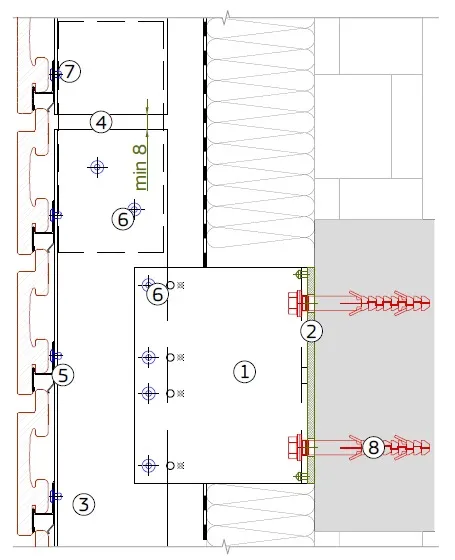
This aluminum system is designed for vertical substructures in ventilated facades and includes wall brackets, profiles, and accessories. Bracket extenders allow for different cladding indents from the wall. Wall brackets are available in 45–305 mm (with isolator) and 40–300 mm (without isolator), in 10–30 mm increments, and three sizes (S, M, L). Brackets feature various hole geometries for installation with anchors or screws.
Brackets with preassembled isolators reduce thermal bridging by separating the substructure from the base wall, enhancing the building’s thermal efficiency. Each bracket includes two fixing points: fixed and sliding. Fixed points support the weight of the cladding and window loads, while sliding points compensate for thermal expansion. Both are clearly marked to prevent mounting errors.
Vertical profiles are attached to brackets using specially designed screws or rivets. Fixed points hold the profile in place, and sliding points allow smooth movement, preventing stress from thermal expansion. A fastening clip on the bracket ensures correct positioning during installation, simplifying alignment and reducing mounting time.
Cladding materials, typically sheet panels, are directly fastened to the profiles using rivets or screws, providing a secure and efficient façade solution.
Invisible Horizontal profiles (mortar)
MVe-Light V11
EnVe-Light V11
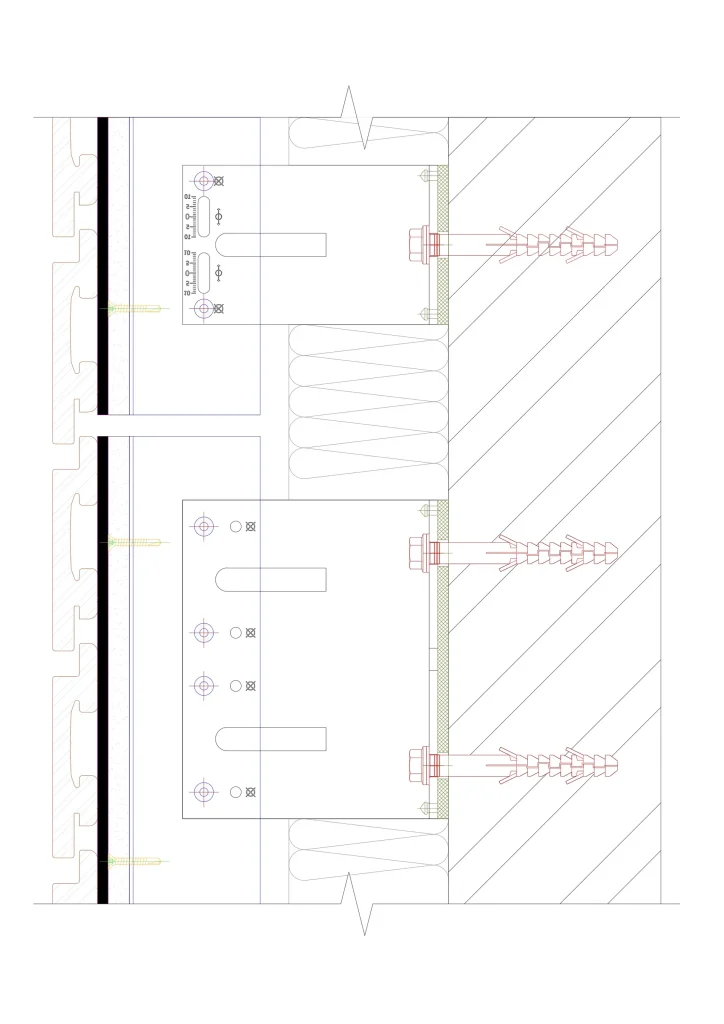
This aluminum system is designed for vertical substructures in ventilated facades and includes wall brackets, profiles, and accessories. Bracket extenders allow for different cladding offsets. Wall brackets are available from 45–305 mm (with isolator) and 40–300 mm (without isolator), in 10–30 mm increments, and three sizes (S, M, L). They feature various hole geometries for installation with anchors or screws.
Brackets with preassembled isolators reduce thermal bridging by separating the substructure from the base wall, improving the building’s energy efficiency. Brackets include fixed and sliding fixing points—fixed points support façade and window loads, while sliding points compensate for thermal expansion. Clear markings prevent mounting errors.
Vertical profiles are attached using special screws or rivets. Fixed points secure the profile, and sliding points allow frictionless movement. A fastening clip aids alignment and speeds up installation.
Clinker tiles, which imitate brick, are used as the facing material. They are fixed using horizontal perforated profiles or a system profile with perforated tape, mounted on vertical rails. Tiles have grooves along their edges to lock onto the profiles, and joints are filled with mortar, ensuring secure, durable adhesion.
Invisible Horizontal profiles (dry)
MVe-Light V11
EnVe-Light V11
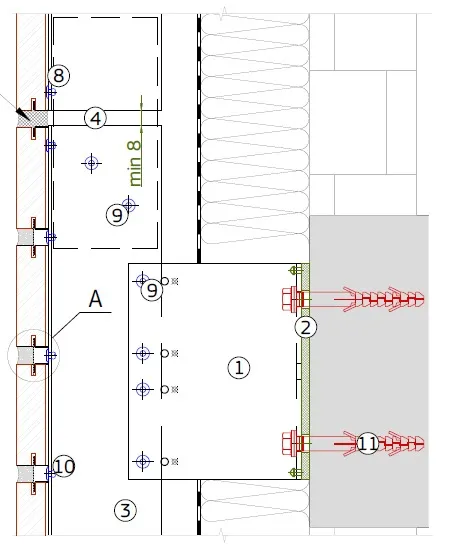
This aluminum system is designed for vertical substructures in ventilated facades and includes wall brackets, profiles, and accessories. Bracket extenders enable different cladding offsets. Wall brackets range from 45–305 mm (with isolator) and 40–300 mm (without isolator), in 10–30 mm increments, and come in three sizes (S, M, L). They feature various hole geometries for anchor or screw installation.
Brackets with preassembled isolators minimize thermal bridging by separating the substructure from the wall, improving overall energy efficiency. Each bracket includes fixed and sliding fixing points: fixed points bear the load of the cladding and windows, while sliding points absorb thermal expansion. Markings help avoid mounting errors.
Vertical profiles are connected to the brackets using special screws or rivets. Fixed points keep the profile secure, while sliding points allow free movement. A fastening clip simplifies alignment and installation.
Clinker tiles, which imitate brick, are used as the cladding material. They are mounted using horizontal perforated profiles or system profiles with perforated tape, attached to vertical rails. The tiles are slotted into place via grooves and fixed with mortar, ensuring strong adhesion and a clean finish.